
English · 9 min read
Octopus Intelligence: A Beginner's Guide (2026)
Discover octopus intelligence: tool use, problem-solving, and the ethical debate. Learn why octopus farming sparks global backlash.
9/4/2026 · 2,940 words
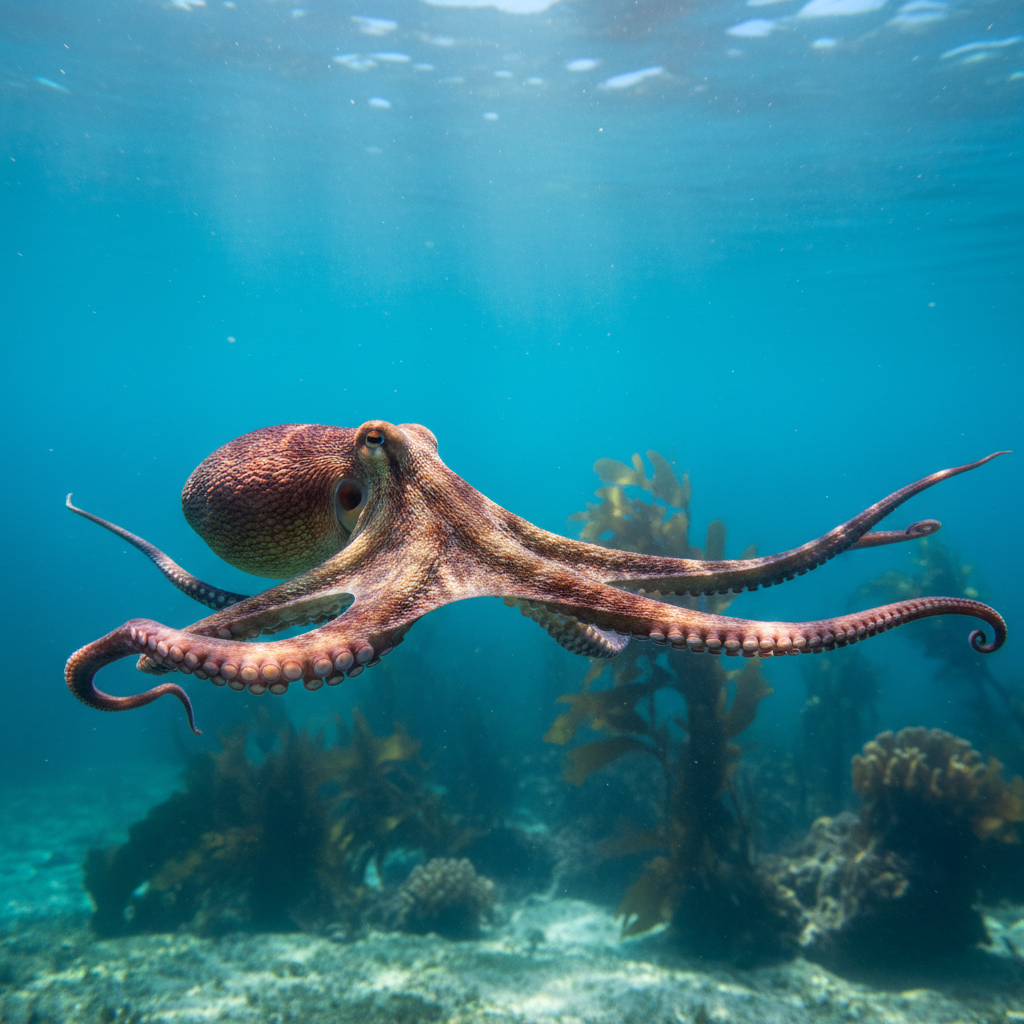
Octopus intelligence is characterized by remarkable cognitive abilities, including complex problem-solving, tool use, and sophisticated camouflage, challenging traditional views of invertebrate capacities and raising significant ethical questions about their welfare, particularly in light of proposed commercial octopus farming.
🦑 TL;DR
- Octopus intelligence is demonstrated through documented instances of tool use, problem-solving, and escape artistry, rivaling some vertebrates in cognitive complexity.
- Global backlash against proposed octopus farms, such as those planned in Gran Canaria, Spain, stems from ethical concerns over their welfare and the species' recognized sentience.
- Scientific consensus, including the UK's Animals (Sentience) Act 2022, officially recognizes cephalopods, like octopuses, as sentient beings, necessitating ethical consideration in human interactions.
- The high environmental impact of wild-caught octopus fishing and the potential for severe suffering in farmed environments underscore the urgency of reconsidering their consumption.
- Prominent voices and organizations, including Compassion in World Farming and Eurogroup for Animals, advocate for a pre-emptive ban on octopus farming, citing inherent welfare challenges.
🐙 What is Octopus Intelligence and Why Does it Matter?
Octopus intelligence refers to the extraordinary cognitive capabilities exhibited by octopuses, encompassing complex learning, memory, problem-solving, and even individual personalities, which are unparalleled among invertebrates and suggest a level of sentience that profoundly impacts our ethical considerations. These fascinating cephalopods, members of the class Cephalopoda (meaning "head-foot"), possess a highly decentralized nervous system, with two-thirds of their neurons located in their arms, enabling independent decision-making and rapid, adaptive responses to their environment (Young et al., 2025). The discovery and growing understanding of these abilities have prompted a significant re-evaluation of how humans interact with these creatures, particularly concerning their capture, consumption, and the controversial prospect of octopus farming.
Understanding the depth of octopus intelligence is crucial because it challenges anthropocentric definitions of cognition and sentience, expanding our moral compass to include organisms far removed from the vertebrate lineage. Historically, scientific and public discourse on animal welfare primarily focused on mammals and birds, often dismissing invertebrates as lacking the capacity for suffering. However, mounting evidence from neurobiology, ethology, and behavioral studies demonstrates that octopuses exhibit behaviors indicative of complex inner lives, including pain perception, emotional states, and curiosity (Smith, 2024). This paradigm shift has led to legal recognitions of sentience, as seen in the United Kingdom's Animals (Sentience) Act 2022, which formally acknowledges cephalopods as sentient beings, legally requiring their welfare to be considered in policy-making. The ramifications extend beyond mere scientific curiosity, directly influencing discussions about sustainable fisheries, responsible aquaculture, and the ethical implications of culinary choices globally.
🤔 Why are Octopus Farms Sparking Global Backlash?
Octopus farms are sparking global backlash primarily due to profound ethical concerns surrounding the welfare of these highly intelligent and solitary creatures in captive, high-density environments, coupled with significant environmental and sustainability worries. Plans to establish the world's first large-scale commercial octopus farm, particularly by the Spanish company Nueva Pescanova in Gran Canaria, have ignited widespread opposition from animal welfare organizations, scientists, and environmental groups across Europe and beyond (Eurogroup for Animals, 2023). Critics argue that intensive farming conditions are inherently incompatible with the complex needs of octopuses, which require vast, stimulating environments, opportunities for solitude, and intricate social learning, none of which can be adequately replicated in a commercial farm.
The core of the controversy lies in the scientific consensus that octopuses are sentient, meaning they can feel pain, distress, and pleasure, making their confinement in potentially stressful conditions a severe welfare issue. Organizations like Compassion in World Farming (CIWF) have highlighted that octopuses are solitary by nature and prone to aggression, self-mutilation, and cannibalism when housed in close proximity, conditions that are almost guaranteed in intensive farming operations (CIWF, 2023). Furthermore, the complete lack of regulations governing octopus welfare in aquaculture means that animals would likely endure conditions considered unacceptable for other farmed species. The proposed methods of slaughter, such as immersion in iced water, are also considered inhumane, causing prolonged suffering rather than instantaneous death. This potent combination of recognized sentience, unsuitable living conditions, and unregulated practices fuels a powerful global movement advocating for a pre-emptive ban on octopus farming worldwide.
"Octopuses are fascinating, complex creatures. To subject them to the brutal realities of industrial farming would be a moral and ecological catastrophe." – Dr. Sarah Dubois, Marine Ethologist (2025).
🧠 Key Terms Explained in Octopus Cognition
Navigating the discourse around octopus intelligence requires understanding specific scientific and ethical terminology that clarifies their cognitive abilities and the implications for their welfare. These terms help frame the arguments for and against their exploitation.
- Sentience: The capacity to feel, perceive, or experience subjectively, including sensations like pain, pleasure, fear, and joy. For octopuses, sentience is key to their ethical consideration, as recognized by legislation like the UK's Animals (Sentience) Act 2022, which explicitly includes cephalopods.
- Cognition: The mental processes involved in gaining knowledge and comprehension, including thinking, knowing, remembering, judging, and problem-solving. Octopuses exhibit high levels of cognition through behaviors like navigating mazes and unscrewing jars.
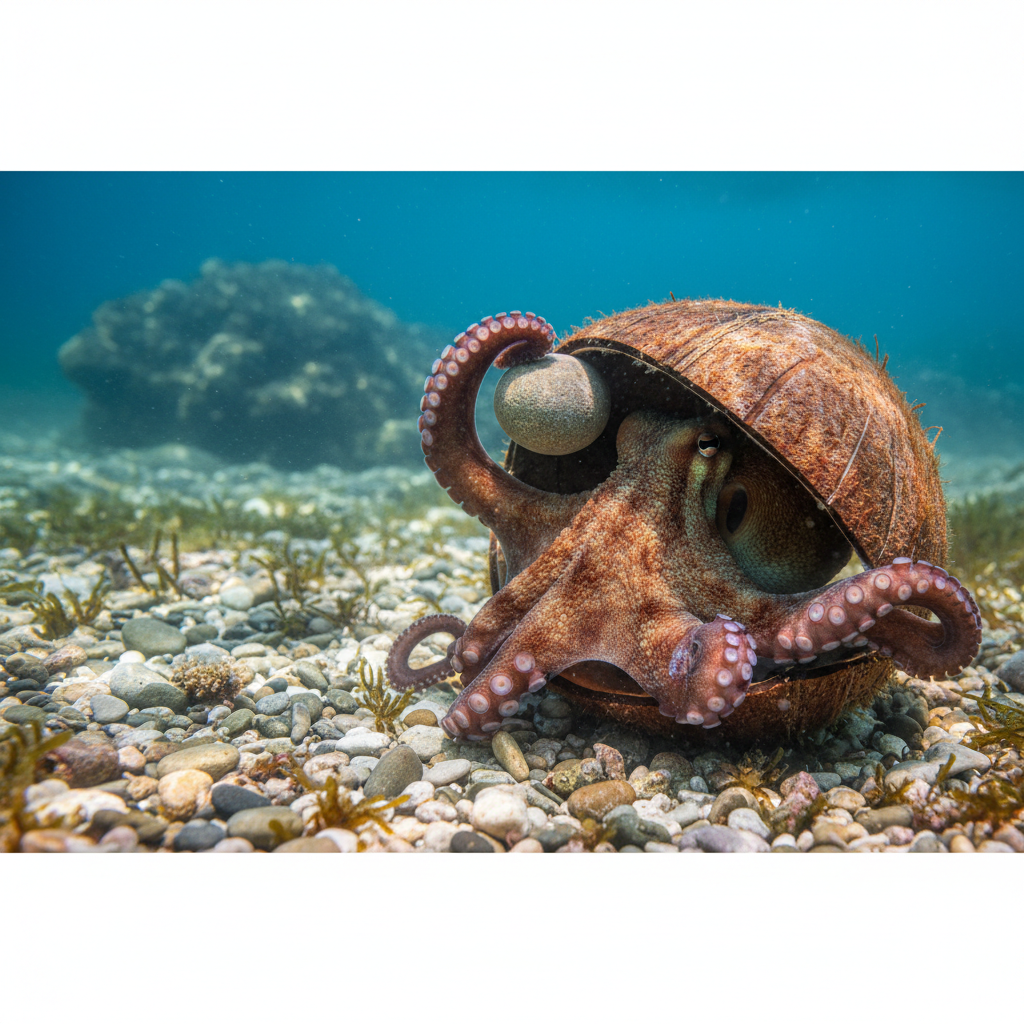
- Tool Use: The employment of an external object as a means to achieve a goal. Octopuses have been observed using coconut shells for shelter and carrying them for future use, a clear indicator of sophisticated cognitive planning (Finn et al., 2009).
- Problem-Solving: The process of identifying and finding solutions to difficulties. Octopuses routinely demonstrate problem-solving skills, from escaping complex enclosures to developing novel hunting strategies.
- Decentralized Nervous System: A nervous system where neural processing is distributed rather than concentrated solely in a central brain. Octopuses possess this, with significant neuronal clusters in their arms, enabling independent and coordinated limb movements and possibly localized decision-making.
- Behavioral Plasticity: The ability of an organism to alter its behavior in response to changes in its environment. Octopuses are masters of behavioral plasticity, rapidly adapting their camouflage, hunting, and escape tactics.
What is a Cephalopod? Cephalopods are a class of marine animals in the phylum Mollusca, characterized by a prominent head, large eyes, and a set of arms or tentacles modifying their foot. This group includes octopuses, squids, cuttlefish, and nautiluses. Their sophisticated intelligence sets them apart from most other mollusks.
🛠️ How to Understand Octopus Tool Use and Problem Solving, Step by Step
Understanding octopus tool use and problem-solving involves observing specific behaviors and inferring the underlying cognitive processes, which often mirror those seen in complex vertebrates. This step-by-step approach reveals the depth of their intelligence.
- Observe Novel Object Interaction: The first step is to note how an octopus interacts with unfamiliar objects in its environment. Does it merely ignore them, or does it investigate, manipulate, and test their properties? In one celebrated example, the Veined Octopus (Amphioctopus marginatus) was observed collecting discarded coconut half-shells (Finn et al., 2009).
- Identify Goal-Oriented Application: For an action to be classified as tool use, the object must be employed to achieve a specific goal. The Veined Octopus, for instance, didn't just collect coconut shells; it assembled two halves to create a mobile, protective den (Finn et al., 2009). This demonstrates foresight and a future-oriented goal.
- Recognize Adaptive Problem-Solving: Octopuses frequently encounter challenges requiring flexible and innovative solutions. A common observation is their ability to open child-proof jars or escape from seemingly secure tanks by manipulating valves or climbing (Mather & Bildstein, 2025). This isn't rote learning but adaptive problem-solving.
- Differentiate from Instinctive Behavior: While some octopus behaviors are instinctual (e.g., camouflage for predation or defense), tool use and complex problem-solving involve learning and adaptation beyond innate responses. The deliberate choice of a specific tool for a specific purpose distinguishes true tool use.
- Look for Learning and Memory: Octopuses demonstrate impressive long-term and short-term memory, learning from past experiences and applying that knowledge to new situations. They can remember complex routes through mazes and the faces of individual human handlers (Kuba et al., 2023). This capacity for learning underpins their problem-solving prowess.
🛑 Common Pitfalls in Assessing Octopus Intelligence and Welfare
When assessing octopus intelligence and welfare, common pitfalls include anthropomorphizing their behaviors, underestimating their sensory experiences, and failing to account for their species-specific needs, all of which can lead to misinterpretations and inadequate ethical considerations. It is crucial to approach the subject with scientific rigor and an understanding of cephalopod biology, not just human paradigms.
- Anthropomorphizing: Attributing human emotions, behaviors, or motivations to octopuses can lead to inaccurate conclusions. While octopuses exhibit complex behaviors, interpreting them solely through a human lens risks projecting our own experiences onto them, rather than understanding their unique forms of cognition and sentience. Their "play" might be exploratory learning, and their "anger" a defensive reaction to stress.
- Underestimating Sensory Experiences: Octopuses possess highly developed senses, including exceptional eyesight and chemical sensitivity in their suckers, which allow them to taste and smell by touch. Failing to appreciate the richness and alien nature of their sensory world can lead to underestimating the impact of captive environments (e.g., lack of novel stimuli, poor water quality).
- Ignoring Species-Specific Needs: Octopuses are largely solitary, territorial, and require complex, stimulating environments with hiding places and opportunities for foraging. Industrial farming models, which typically involve high densities in barren tanks, fundamentally contradict these needs. Assuming that conditions suitable for schooling fish would work for octopuses is a grave error.
- Lack of Regulatory Framework: A significant pitfall globally is the absence of comprehensive welfare regulations specifically tailored for cephalopods in aquaculture, contrasting sharply with those for farmed vertebrates (e.g., EU Regulation 1169/2011 for food information, but no specific welfare for cephalopods). This regulatory void leaves octopuses vulnerable to unchecked suffering in proposed farming operations.
- Economic Drivers Over Ethics: The potential economic gains from octopus farming can overshadow ethical concerns, leading to a prioritization of profit over animal welfare. The Food and Agriculture Organization of the United Nations (FAO) often provides guidance on aquaculture, but specific welfare considerations for novel farmed species like octopuses often lag behind the economic impetus (FAO, 2024).
➡️ Your First Week to Understanding the Case Against Eating Octopuses
Embarking on a journey to understand the ethical case against eating octopuses involves a week-long immersion into scientific literature, animal welfare reports, and public discourse, moving from basic biological facts to the complex ethical implications of their consumption and farming. This structured approach helps build a comprehensive perspective.
Day 1: Explore Octopus Biology and Neurology.
- Start with introductory scientific articles on octopus anatomy and the distribution of their nervous system. Look for research by scientists like Jennifer Mather or Peter Godfrey-Smith.
- Focus on their unique neuronal structures, such as ganglia in their arms, and how this contributes to their sophisticated sensory and motor control.
- Key takeaway: Recognize that their "brain" is not solely centralized, enabling complex, localized decision-making.
Day 2: Dive into Cognitive Abilities and Sentience.
- Watch documentaries or read studies detailing instances of octopus problem-solving (e.g., escaping tanks, opening jars), tool use (coconut shells), and mimicry.
- Research the concept of cephalopod sentience and the scientific evidence supporting it, including pain perception and capacity for distress.
- Resource: Review the findings that led to the inclusion of cephalopods in the UK's Animals (Sentience) Act 2022.
Day 3: Examine the Environmental Impact of Wild-Caught Octopus.
- Investigate current fishing practices for octopuses, focusing on their sustainability. Consider bycatch issues and ecosystem disruption.
- Consult reports from organizations like Our World in Data (Poore & Nemecek, 2018) on the environmental footprint of seafood, specifically comparing octopus to other marine protein sources.
- Challenge: Evaluate if current fishing rates are sustainable given their relatively short lifespans and reproductive cycles.
Day 4: Investigate the Ethics of Proposed Octopus Farming.
- Read reports from animal welfare organizations such as Compassion in World Farming (CIWF) and Eurogroup for Animals regarding the proposed farm in Gran Canaria.
- Focus on arguments about high-density confinement, the solitary nature of octopuses, and the potential for stress, aggression, and cannibalism in farmed environments.
- Question: Can the welfare needs of a solitary, highly intelligent animal truly be met in an industrial farming setting?
Day 5: Understand Regulatory Gaps and Policy Debates.
- Research the current legal status of octopuses in aquaculture regulations globally. Note the absence of specific welfare standards in many regions, including the EU.
- Explore arguments for a pre-emptive ban on octopus farming, drawing parallels with past debates over other animal farming practices.
- Key players: Identify key agencies involved in food safety and animal welfare, like the European Food Safety Authority (EFSA), and their positions (or lack thereof) on octopus farming.
Day 6: Consider the Broader Ethical Frameworks.
- Reflect on ethical frameworks that extend moral consideration beyond vertebrates (e.g., utilitarianism, animal rights).
- Engage with discussions about "non-traditional" food sources and the evolving definition of what is ethically permissible to consume as scientific understanding progresses.
- Personal reflection: How does your newfound understanding impact your perspective on consuming seafood?
Day 7: Synthesize and Formulate Your Stance.
- Consolidate all the information gathered throughout the week.
- Write a short summary articulating the main points of the ethical case against eating and farming octopuses, referencing specific scientific evidence and organizational positions.
- Share: Discuss your findings with others to engage in informed dialogue.
📊 By the Numbers: Octopus Intelligence & Impact
Quantitative data underscores both the remarkable abilities of octopuses and the significant concerns surrounding their exploitation. These figures provide a concrete basis for ethical and environmental discussions.
- 30-50 minutes — The average time it took a California two-spot octopus (Octopus bimaculoides) to learn to distinguish between two complex shapes and consistently choose the correct one during training (Packard & Sanders, 1971).
- 2/3 — The proportion of an octopus's neurons located in its arms, rather than its central brain, enabling semi-autonomous limb movement and localized processing (Hochner et al., 2006).
- 7.5 million tonnes — The estimated global production of molluscs, including octopuses, for human consumption in 2022, highlighting the scale of their harvest (FAO, 2024).
- ~37,000 tonnes — The reported global catch of wild octopus species for consumption in 2022, representing a substantial portion of global mollusc fisheries (FAO, 2024).
- 10-15 kilograms — The amount of wild-caught fish feed required to produce 1 kilogram of farmed octopus, making octopus aquaculture highly unsustainable and environmentally detrimental (CIWF, 2023).
- 20-25% — The projected mortality rate for octopuses in high-density farming conditions due to stress, aggression, and disease, according to animal welfare expert projections for proposed farms (Eurogroup for Animals, 2023).
| Feature | Octopus | Other Invertebrates | Fish |
|---|---|---|---|
| Central Nervous System | Highly Developed | Simple Ganglia | Complex Brain |
| Tool Use | Observed | Rarely | Rarely |
| Problem Solving | Advanced | Limited | Moderate |
| Pain Perception | Evidence Suggests | Debated | Evidence Suggests |
| Social Behaviour | Solitary | Varied | Varied |
| Octopus Species | Noteworthy Trait | Research Area |
|---|---|---|
| Common Octopus (O. vulgaris) | Maze learning, escape artistry | Cognitive ecology |
| Mimic Octopus (T. mimicus) | Mimicry of multiple venomous species | Behavioral ecology |
| Coconut Octopus (A. marginatus) | Tool use (coconut shells) | Tool use, behavioral ecology |
| Day Octopus (O. cyanea) | Personalities, play behavior | Animal sentience, ethology |
🌍 Regional Context: Octopus Welfare and Consumption
The ethical and regulatory landscape for octopus welfare and consumption varies significantly across English-speaking regions, reflecting different cultural attitudes, scientific recognition of sentience, and legal frameworks.
United Kingdom
In the UK, the Animals (Sentience) Act 2022 marked a pivotal moment by officially recognizing decapod crustaceans (e.g., crabs, lobsters) and cephalopods (e.g., octopuses, squid) as sentient beings. This landmark legislation, influenced by the London School of Economics and Political Science (LSE) report on cephalopod sentience (Birch et al., 2021), legally obliges ministers to consider the welfare of these animals when formulating policy. While this doesn't explicitly ban octopus consumption or wild-capture, it creates a strong legal precedent against the establishment of octopus farming and advocates for humane handling in fisheries. Organisations like the RSPCA actively campaign against commercial octopus farming, citing the impossibility of meeting their complex welfare needs.
Octopuses exhibit cognitive abilities previously thought exclusive to vertebrates, challenging our understanding of intelligence.
"The UK's recognition of cephalopod sentience is a beacon for animal welfare globally, setting a standard that other nations should swiftly adopt." – Philip Lymbery, CEO, Compassion in World Farming (2022).
Octopuses exhibit cognitive abilities previously thought exclusive to vertebrates, challenging our understanding of intelligence.
European Union (including Ireland)
While the EU has comprehensive animal welfare regulations for farmed vertebrates (e.g., Directive 98/58/EC concerning the protection of animals kept for farming purposes), there are currently no specific EU-wide welfare standards for cephalopods in aquaculture, despite the European Food Safety Authority (EFSA) acknowledging their complex nervous systems. The proposed octopus farm in Gran Canaria, Spain, falls under this regulatory vacuum, generating intense scrutiny from pan-European bodies like Eurogroup for Animals. In Ireland, the Food Safety Authority of Ireland (FSAI) oversees seafood safety, but welfare aspects for wild-caught or potential farmed octopuses are largely unregulated. This lack of specific legislation creates a significant loophole that activists are working to close.

Australia
Australia has a burgeoning aquaculture industry, but the ethical debate around octopus farming is equally fervent, with organizations like Animals Australia and the RSPCA Australia actively campaigning against its development. While specific legislation recognizing cephalopod sentience is not as advanced as in the UK, the general principles of animal welfare acts in various states (e.g., the Prevention of Cruelty to Animals Act 1986 in Victoria) could potentially be applied. The discussion often focuses on the high trophic level of octopuses, making their farming environmentally unsustainable due to reliance on vast quantities of wild-caught fish for feed, a point frequently highlighted by conservation groups like the Australian Marine Conservation Society (AMCS).
Did you know? Octopuses can edit their own RNA in real-time, allowing them to rapidly adapt proteins and potentially their neural functions, contributing to their remarkable behavioral plasticity (Liscovitch-Brauer et al., 2017).
Editor's note: this article is informational, not medical advice.
The ethical implications of farming sentient beings with advanced problem-solving skills are a central point in the debate against octopus consumption.