Vegan · breakfast
Vegan Overnight Oats (5 Easy Flavours)
A no-cook breakfast you prepare in two minutes the night before. One base recipe plus five flavour ideas.
Jump to recipe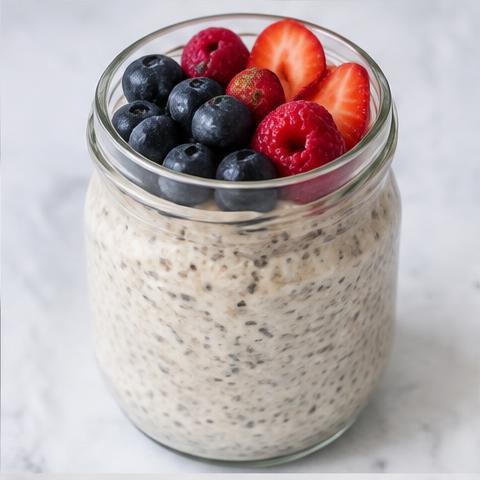
- Prep
- 5 min
- Cook
- 0 min
- Prep + cook
- 5 min
- Serves
- 1
Soaking, resting, cooling and chilling may take extra time; see the cooking guide below. Approximately 350 kcal per serving, excluding optional sides and toppings.
Ingredients
Method
- Stir the oats, milk, yogurt, chia, maple syrup and salt together in a jar.
- Add your flavour (see tips), close the lid and refrigerate overnight or at least 4 hours.
- Stir in the morning, loosen with a splash of milk if needed, and add toppings.
Cook's notes
- Berry: frozen berries and lemon zest.
- Chocolate: 1 tbsp cocoa and sliced banana.
- Apple pie: grated apple, cinnamon and walnuts.
- Peanut butter: 1 tbsp peanut butter and raspberries.
- Tropical: mango, coconut flakes and lime.
Why this recipe works
This vegan overnight oats formula relies on the principles of absorption and hydration to transform raw, rolled oats into a creamy, pudding-like breakfast without any heat. By combining rolled oats with a specific ratio of liquid, starch, and thickeners, the starch granules slowly hydrate over several hours, resulting in a tender texture rather than a mushy one. This method removes the need for cooking time, making it an ideal candidate for meal prep that occupies almost zero active effort in the kitchen.
The inclusion of chia seeds acts as the structural foundation of the recipe. These small seeds have a high capacity to absorb liquid and form a gel-like coating, which provides the necessary body to the mixture. Chia adds thickness; without it, reduce the liquid or increase oats or yogurt. With chia, the oats gain a satisfying, spoonable consistency that mimics a traditional custard. This reaction occurs effectively at cold temperatures, allowing the refrigerator to do the heavy lifting while you sleep, with a minimum soak time of four hours.
The recipe is designed as a base for versatility, allowing you to scale up ingredients according to appetite without compromising the hydration balance. The total prep time is approximately five minutes, excluding the four-hour chilling window required for the oats to soften sufficiently. By balancing the acidity of plant yogurt with the sweetness of maple syrup, this dish creates a neutral, satisfying base that can be customized to your preference using the five distinct flavor variations provided for variety.
Because this is a cold-soak process, the final texture is determined by the quality of the rolled oats. Old-fashioned rolled oats are superior to quick oats here, as the former hold their shape while softening, whereas quick oats tend to disintegrate into a paste. The five-minute prep window encompasses the mixing of all dry and wet ingredients in a single container. Once combined, the mixture requires no further intervention until you are ready to consume it the following morning, making it highly efficient.
Ingredient choices and preparation
Rolled oats, also known as old-fashioned oats, are the essential component of this dish. Avoid steel-cut oats, which are too hard for cold absorption, and instant oats, which turn mushy quickly. The oats act as the primary fiber and complex carbohydrate source. The half-cup measurement is calibrated to produce a substantial serving that expands slightly as the grain absorbs the liquid, ensuring a texture that is neither too dry nor too thin once fully saturated after the mandatory overnight refrigeration period.
The choice of plant milk and plant yogurt significantly influences the flavor profile and richness of the final product. Soy or oat milk generally provides a creamier result than almond milk due to higher protein content. The plant yogurt adds tang and thickness, preventing the oats from feeling like simple cereal in milk. Ensure the plant yogurt is plain and unsweetened, as the maple syrup provides the necessary sweetness, allowing you to control the sugar levels precisely during the mixing process.
Chia seeds help achieve the stated texture, but can be omitted with a liquid adjustment, functioning as the thickening agent that creates the desired mouthfeel. Ensure your seeds are whole; ground chia will thicken the mixture too rapidly and result in a gummy texture. The pinch of salt is a vital culinary enhancer that balances the sweetness of the maple syrup and brings out the nutty flavor of the oats. If your maple syrup is particularly robust, adjust the quantity down to one teaspoon to avoid overpowering the natural grain flavor.
For the various flavor profiles, freshness is key. When choosing fruit for the flavor variations, ensure ingredients like grated apple or mashed banana are added at the time of assembly to prevent oxidation. Frozen berries are excellent for the berry variation as they release juices as they thaw overnight, naturally flavoring the milk throughout the mixture. Always keep your nut or seed toppings in an airtight container to preserve their crunch, adding them only right before serving to prevent sogginess.
Equipment and kitchen setup
The primary piece of equipment needed is a container with a secure, airtight lid. A standard wide-mouth mason jar is the industry standard for overnight oats because it allows for easy access with a spoon and is sturdy enough to withstand the refrigerator environment. A capacity of 16 ounces is ideal, as it provides enough headspace for the ingredients to expand and allows for vigorous shaking or stirring to combine the base elements thoroughly before they are set aside to soak.
A small whisk or a sturdy spoon is necessary for the initial mixing. Since chia seeds have a tendency to clump upon hitting liquid, you must ensure that every seed is fully dispersed within the mixture. If you do not mix the seeds adequately, you will end up with pockets of dry clumps. Taking a few extra seconds to scrape the bottom edges of the jar with a silicone spatula ensures that no dry oats remain trapped against the glass, which would lead to uneven hydration.
Measuring cups and spoons are required for consistency. Because overnight oats rely on the specific ratio of liquid to grain, accurate measurements prevent a result that is too soupy or too tight. If you prefer to minimize dishes, you can weigh your ingredients directly into the jar using a digital kitchen scale. A half-cup of rolled oats generally weighs 45 grams, and a half-cup of plant milk weighs approximately 120 milliliters. Precision at this stage guarantees a consistent texture every single time.
While not strictly required, a set of small silicone spatulas is highly recommended for transferring yogurt and fruit components without leaving residue behind. If you are preparing multiple jars for the work week, using stackable glass containers saves significant space. Ensure your refrigerator is consistently kept at 4 C or colder. This temperature is crucial for food safety, particularly when working with perishable yogurt and plant milk, and it also dictates the rate at which the oats soften over the required hours.
Cooking technique in detail
The technique is fundamentally about creating a stable emulsion of grain, liquid, and seeds. Start by adding the milk and yogurt to the jar first; liquid at the bottom prevents the oats from sticking to the base. Follow with the chia seeds, salt, and maple syrup, whisking these into the liquids until the syrup is fully dissolved. Only after the liquids are consistent should you fold in the rolled oats. This order of operations minimizes the risk of dry, unmixed spots that can plague the process.
Once the mixture is combined, the 'cooking' occurs through passive hydration. The oats require a minimum of four hours to soften. During the first hour, the chia seeds will begin to absorb liquid, creating a thick viscosity. If you find the mixture looks too loose after ten minutes of standing, do not add more oats; the seeds will continue to thicken the liquid throughout the night. Trust the ratio provided, as the cold environment effectively slows the hydration process to reach the perfect texture.
After the overnight rest, the consistency will be quite firm due to the chia gel. Before eating, stir the mixture vigorously for 30 seconds. If the result is too thick for your preference, add one or two tablespoons of additional plant milk to loosen the texture. This final adjustment allows you to customize the mouthfeel to your exact liking, whether you prefer a loose porridge style or a thicker, spoonable texture that holds its form on a spoon.
Temperature management is the final step in the technique. While the oats are designed to be eaten cold directly from the refrigerator, you may serve them in a bowl if you prefer toppings that require aesthetic placement. If you choose to add toppings like coconut flakes, nuts, or fresh fruit, wait until the final stir. Adding crunchy elements the night before will result in them losing their structural integrity, detracting from the overall contrast that makes the dish enjoyable.
What to look for
Mixing
The mixture should look consistent with no dry clumps of oats or chia seeds visible.
Soaking
The oats should be soft to the bite and the liquid should be fully thickened by the chia gel.
Adjusting
The texture should be loose enough to be stirred easily without appearing like a solid block.
Serving
The toppings should be added only at the very end to maintain their specific texture.
Serving ideas and variations
Serving overnight oats is an exercise in contrast. Because the base is smooth and soft, the most successful servings involve adding textures that provide a crunch or a burst of acidity. For the apple pie variation, adding toasted walnuts right before serving provides a necessary textural offset to the softened oats. When serving, ensure the container is wiped clean and the topping is arranged artistically to enhance the experience, which can make the breakfast feel more like a composed dessert or a cafe-style meal.
Flavor variations can be incorporated during the prep phase or used as toppings. For the tropical variation, mix the mango and lime juice directly into the base before refrigerating; the acidity of the lime works well with the mango to brighten the flavor. However, for the peanut butter and raspberry version, stir the peanut butter into the base but save the fresh raspberries for the morning. Fresh fruit added the night before can turn mushy, whereas fresh fruit added at the moment of serving stays bright and vibrant.
Temperature-wise, these oats are intended for cold consumption. However, if you find the coldness off-putting, you can transfer the mixture to a microwave-safe container and heat it for 30 to 60 seconds on high. Do not exceed this duration, as the chia seeds can become overly thick and the oats can lose their bite. Stir thoroughly after heating, as microwaves often heat unevenly. This method is the only acceptable way to consume the dish warm without compromising the structural balance of the ingredients.
Creative plating options include layering the oats with additional yogurt or fruit purees to create a parfait. If you are serving this for a brunch or guest, consider using small glass jars and garnishing with fresh herbs like mint or basil, which pair unexpectedly well with the tropical and berry flavor variations. These small touches elevate the simplicity of the recipe into a refined, visually appealing morning dish that maintains its integrity as a healthful and satisfying vegan breakfast option.
Make ahead, storage and reheating
Overnight oats are the definition of a make-ahead meal, but they do have a finite shelf life. Because you are combining perishable plant milk and yogurt with shelf-stable grains, the entire mixture should be stored in an airtight container in the coldest part of your refrigerator at 4 C or below. When stored correctly, these jars will maintain optimal quality for three to four days. Beyond this timeframe, the oats may become excessively soft and the liquid may begin to separate from the chia gel.
While it is tempting to prep for an entire week, you will notice a marked difference in quality by day five. The texture tends to lose its distinctiveness as the oats break down entirely into a paste. If you must prepare a large batch, keep the dry oats and chia separate from the wet components until the night before consumption. This 'dry mix' method allows you to have a week's worth of quick meals ready while ensuring each jar is freshly hydrated, resulting in superior texture for every single serving.
Overnight oats can be frozen in individual freezer-safe containers. Milk, yogurt and fruit choice affect how much separation or softening occurs. Leave headspace for expansion, thaw in the refrigerator, stir well and adjust with a little milk if needed. Add delicate fruit or crunchy toppings after thawing. For refrigerated batches, keep the three-to-four-day window and discard oats left at room temperature beyond two hours.
If you are prepping for transport, ensure your container has a leak-proof lid. Since the oats will occupy a significant portion of the jar, leave about an inch of headspace if you plan on adding bulkier toppings like fruit or granola in the morning. This prevents the lid from being difficult to open and keeps your workspace clean. If you are taking the jar to work, keep it in an insulated bag with an ice pack to maintain the integrity of the yogurt-based mixture during your commute.
Nutrition and allergen notes
This recipe provides approximately 350 calories per serving, though this will fluctuate based on the specific plant milk and yogurt brands chosen, as well as the quantity of maple syrup and added fruit. It is a dense source of dietary fiber and complex carbohydrates, making it highly satiating for several hours. The inclusion of chia seeds contributes essential omega-3 fatty acids, providing a nutritional boost that enhances the overall profile of the oats, which are primarily valued for their heart-healthy beta-glucan content.
Soy content depends on the plant milk and yogurt selected: soy milk or soy yogurt makes the base soy-containing. Use suitable soy-free products if needed. Choose certified gluten-free oats when required, and check the rest of the ingredients too. Peanut butter, walnuts and other flavour variations introduce additional allergens. Disclose the actual ingredients rather than describing all versions as having the same allergen profile.
The recipe is naturally free of animal products, including dairy, making it suitable for vegan diets. However, those with specific nut allergies should be vigilant, as almond or cashew milk is a common replacement for oat or soy milk. Always verify the ingredients on your plant-based yogurt, as some thickeners or additives may contain trace amounts of allergens not immediately obvious on the front label. If you are serving this to others, disclose all ingredients used, especially when using nut-based toppings like walnuts.
Because this recipe is served cold and involves raw ingredients, it is vital to maintain strict hygiene during preparation. Use clean utensils and jars to prevent cross-contamination. If you have a sensitive digestive system, the high fiber content of the oats and chia seeds may cause discomfort if you are not accustomed to them. Start with smaller portions and increase them gradually to allow your gut microbiome to adjust to the increased fiber intake. Always store leftovers promptly at 4 C.
Ingredient substitutions
- Maple syrup → Agave nectar
- Use in a 1:1 ratio as it has a similar sweetness profile and liquid consistency.
- Plant yogurt → Extra plant milk
- Add 2 tablespoons extra milk; the result will be thinner but still effective for soaking.
- Chia seeds → Ground flaxseed
- Use 2 tablespoons of ground flax; note that the texture will be slightly more gelatinous.
- Rolled oats → Thin-rolled porridge oats
- Reduce soaking time by 1 hour as they hydrate faster than traditional rolled oats.
Troubleshooting
The mixture is too dry or hard.
Insufficient liquid or too many oats.
Add an extra splash of milk and stir well before serving.
The texture is gummy.
Using ground chia instead of whole seeds.
Ensure you use whole chia seeds in future batches for better mouthfeel.
The oats are still too crunchy.
Soaking time was less than four hours.
Allow the jar to sit at room temperature for 30 minutes to speed up absorption.
The mixture separated in the fridge.
The yogurt was not fully whisked into the milk.
Stir vigorously for one minute to re-emulsify the ingredients.
Recipe questions
Can I prep these more than four days in advance?
It is not recommended. While the oats are safe to consume for up to four days, the quality degrades significantly after that point. The texture becomes overly soft and the flavor profile dulls. For the best experience, limit your prep to a 3-4 day window. If you need food for an entire week, prepare only the base mix for the final days without adding the fruit.
What is the minimum amount of time to soak?
The absolute minimum soaking time is four hours. This duration is necessary for the starch granules in the rolled oats to absorb enough moisture to become tender, and for the chia seeds to fully hydrate and form the gel that gives the dish its structure. If you soak for less than four hours, the oats will remain chewy, which is generally considered unappealing for this specific type of breakfast.
Is it safe to leave these on the counter while they soak?
No. Because this recipe uses perishable plant milk and yogurt, it must be kept in the refrigerator at 4 C or colder. Leaving the jar on the counter for longer than two hours creates an environment where bacteria can multiply rapidly. Always move your assembled jar directly into the refrigerator immediately after mixing to ensure food safety and to allow the thickening process to occur at the correct rate.
Do I have to use chia seeds?
Chia seeds are the primary structural element of this recipe. They absorb liquid to create a thick, pudding-like consistency. If you omit them, the oats will remain separate from the milk, resulting in a thin, watery consistency that is more like cereal than overnight oats. If you have an allergy to chia, you can try flaxseed, though the result will be slightly more gelatinous and less firm in texture.
How do I handle the allergen risk with rolled oats?
Rolled oats are naturally free of gluten, but they are frequently processed in shared facilities with wheat, barley, or rye. If you are strictly gluten-free for health reasons, you must specifically look for packaging labeled 'certified gluten-free.' This ensures that the oats have been processed on dedicated equipment, eliminating the risk of cross-contamination. Always check labels before purchasing, as this is the most common hidden allergen issue with oats.
Replace the job, not just the ingredient
An egg can bind a burger, enrich a cake or create the foam in a meringue. Those jobs need different substitutes: ground flaxseed can help with binding, while aquafaba is useful for whipping.
Review the rewritten method as well as the ingredient list. Changing the amount of liquid, the cooking temperature or the resting time can matter as much as the substitute itself.
- A practical example
- For a creamy pasta, try unsweetened plant cream or blended silken tofu; add acidity and seasoning to taste rather than relying on a cheese substitute alone.
- What to keep in mind
- Substitutions can change allergens, texture and nutrition. Test a small batch before making a dish for guests.
Plan around the week you actually have
Begin with your busiest evenings and choose quick meals for those days. Use slower recipes when you have time, and let overlapping ingredients connect meals rather than planning seven unrelated shopping trips.
Check your pantry before shopping. Choose a protein source, a grain or other starchy food, and vegetables for each main meal; then adjust portions and leftovers for the people eating.
- A practical example
- Roast vegetables for dinner, use the remaining vegetables in a chickpea bowl, and turn spare rice into a quick tofu stir-fry.
- What to keep in mind
- A plan is a starting point, not a prescription. Check food-storage advice and adjust it for allergies, appetite and dietary needs.
Read the pattern, not just one number
Portion size, brand and preparation method change the numbers in a food log. Check whether an entry describes cooked or dry food, and choose the closest match to what you actually ate.
Look across several days rather than judging one meal. Protein and fibre matter, but so do reliable sources of vitamin B12 and attention to calcium, iodine and vitamin D in a plant-based diet.
- A practical example
- For a lentil bowl, log the cooked lentils, grain, dressing and toppings separately when their amounts are known.
- What to keep in mind
- Food logs are estimates and may not capture every nutrient. Supplement needs and targets should be discussed with a qualified professional when appropriate.