
English · 9 min read
Why Factory Farming is the Climate Fight Nobody Talks About
Industrial animal agriculture is a leading driver of climate change, responsible for a massive share of greenhouse gas emissions, deforestation, and water use. This article breaks down the numbers and explores how meaningful dietary shifts can be one of the most powerful tools for individual climate action.
6/4/2026 · 2,160 words
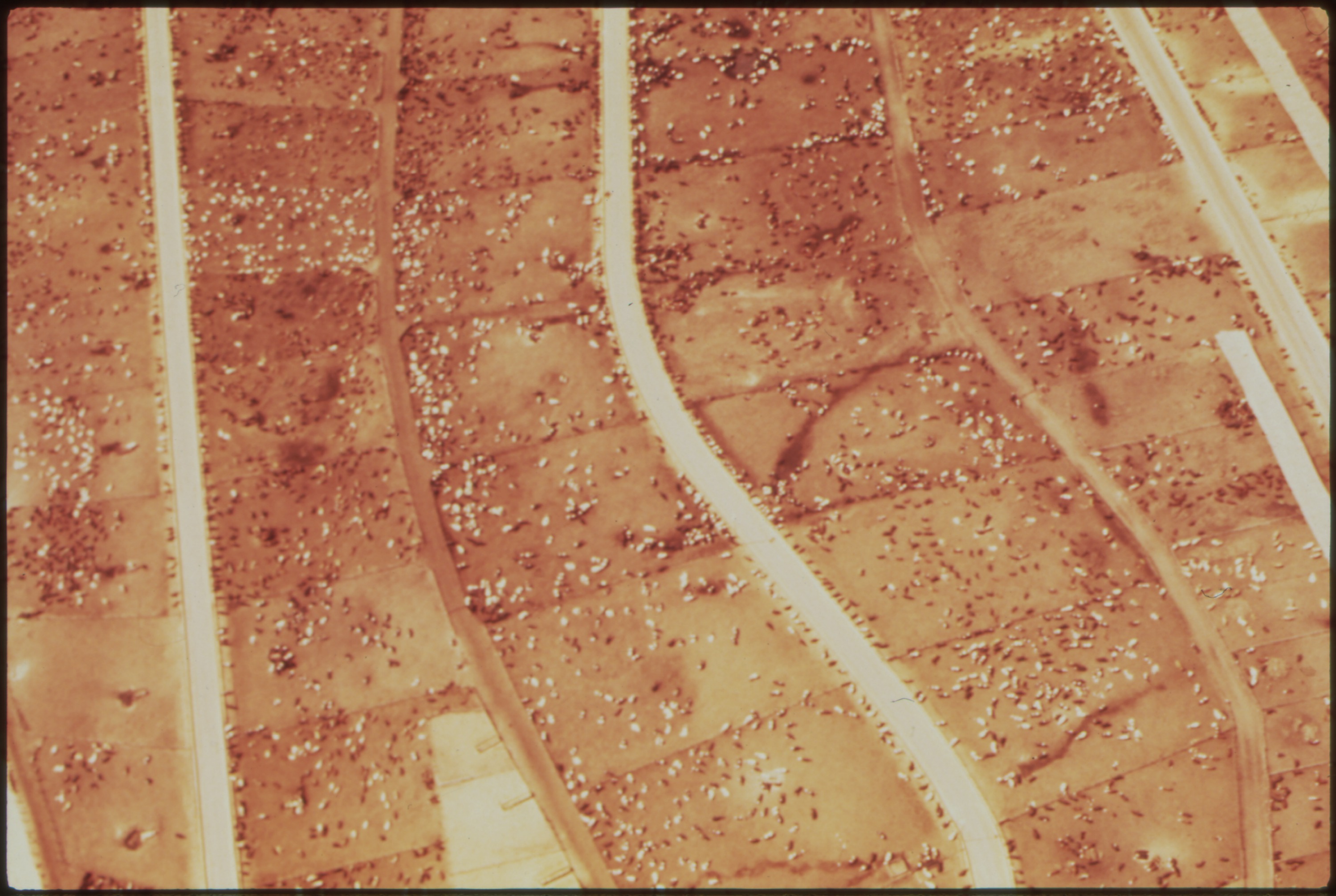
When we picture the fight against climate change, we see vast solar farms shimmering in the desert, sleek electric cars gliding through city streets, and towering wind turbines spinning against a blue sky. We talk about carbon taxes, renewable energy grids, and phasing out fossil fuels. But what about the elephant—or rather, the cow—in the room? The global food system, and specifically industrial animal agriculture, is one of the largest single drivers of climate change, yet it remains conspicuously absent from many mainstream climate conversations. The meal on our plate has a hidden environmental cost that rivals the emissions from our cars, and understanding that cost is the first step toward truly comprehensive climate action. This is the climate fight nobody is talking about.
Gene Daniels · Public domain · via Wikimedia Commons
The footprint, in plain numbers
The sheer scale of animal agriculture's climate impact is staggering. According to the United Nations' Food and Agriculture Organization (FAO), the livestock sector is responsible for a staggering 14.5% of all human-caused greenhouse gas emissions (FAO, 2023). To put that in perspective, it’s a larger share than the entire global transportation sector combined—all the cars, trucks, planes, and ships in the world. The latest data from Our World in Data (2024) reinforces this, showing that the food system as a whole accounts for over a quarter of global emissions, with animal-based foods responsible for the vast majority of that. Beef and lamb alone contribute a disproportionately high amount.
These emissions aren't just carbon dioxide from burning fossil fuels to power farm machinery or transport feed. The problem is a cocktail of three potent greenhouse gases. First, there's CO₂, released from deforestation to clear land for pastures and feed crops. Second, and more critically, is methane (CH₄), released from the digestive processes of ruminant animals like cows and sheep. Third is nitrous oxide (N₂O), a powerful gas released from animal manure and the fertilizers used to grow their feed. The Intergovernmental Panel on Climate Change (IPCC) in its AR6 report emphasizes the importance of tackling these non-CO₂ gases, noting their significant near-term warming potential, which makes them a critical target for rapid climate mitigation.
Breaking down the food chain reveals the inefficiency. We dedicate immense resources—land, water, and energy—to growing crops like soy and corn, only to feed them to animals. This conversion process is incredibly lossy. For every 100 calories of grain we feed to livestock, we only get back about 12 calories in chicken, or a mere 3 calories in beef. This multi-stage process, from growing feed to raising the animal and processing the meat, accumulates a massive environmental footprint that plant-based foods simply do not have. The numbers are plain: our current model of industrial meat production is a colossal and inefficient engine of climate change.
Methane, the inconvenient gas
While CO₂ dominates climate headlines for its longevity in the atmosphere, methane (CH₄) is the powerful, fast-acting gas that makes animal agriculture so uniquely damaging. The primary source of this methane is a natural biological process in ruminant animals called "enteric fermentation." Microbes in the digestive systems of cows, sheep, and goats break down fibrous plants, producing methane as a byproduct, which is then released primarily through burps. With a global cattle population exceeding one billion, the scale of these emissions is immense. Manure decomposition under anaerobic (oxygen-free) conditions in large waste lagoons on factory farms is another significant source of this potent gas.
The reason methane is so concerning is its high "global warming potential" (GWP). While it remains in the atmosphere for a much shorter time than CO₂ (around 12 years compared to centuries), it is far more effective at trapping heat. Over a 20-year period, methane is estimated to be over 80 times more potent at warming the planet than carbon dioxide (IPCC AR6). This makes reducing methane emissions one of the most powerful levers we have to slow down the rate of global warming in the near term, buying us crucial time to tackle longer-term CO₂ challenges.
Because of its short atmospheric lifespan, a significant reduction in global methane emissions would have a near-immediate cooling effect. Climate scientists argue that targeting methane is the "low-hanging fruit" of climate mitigation. While the energy sector also produces methane through natural gas leaks, agriculture remains the largest single source globally. Addressing the emissions from the tens of millions of cattle in the industrial food system isn't just an environmental issue; it’s one of the quickest and most effective climate strategies available to us, yet it’s the one we hear about the least.
 Max Roser · CC BY 4.0 · via Wikimedia Commons
Land use and the Amazon
The climate impact of factory farming extends far beyond gas emissions; it’s etched into the very surface of our planet. Animal agriculture is the single largest user of land on Earth. A landmark study by Poore & Nemecek (2018) found that meat and dairy production uses a staggering 83% of the world's farmland, despite providing only 18% of our calories and 37% of our protein. This immense footprint is a primary driver of deforestation, habitat loss, and biodiversity collapse. Vast tracts of land are cleared for cattle to graze, while even larger areas are used to grow feed crops, predominantly soy and corn.
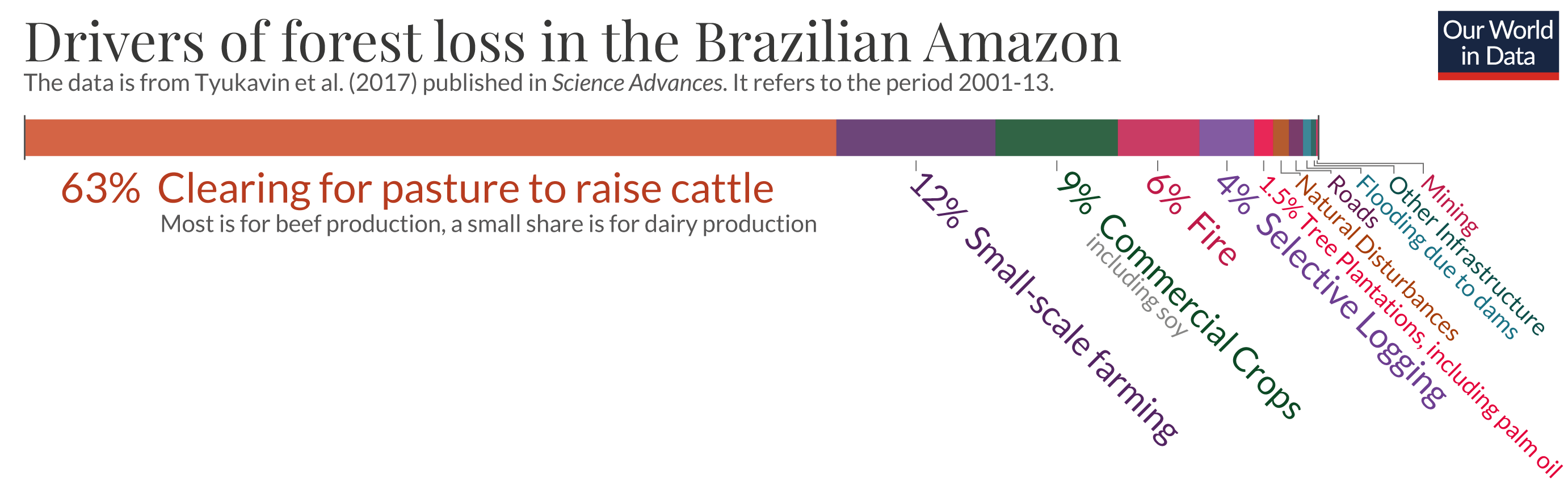
Nowhere is this devastation more apparent than in the Amazon rainforest, the "lungs of the planet." An overwhelming majority of Amazon deforestation—upwards of 80% by some estimates—is directly linked to clearing land for cattle ranching (WWF). The iconic image of the burning rainforest is not an abstract environmental catastrophe; it is, in large part, the cost of cheap beef. This process releases billions of tons of stored carbon into the atmosphere as the forests burn, while simultaneously destroying a vital carbon sink that helps regulate the global climate. The loss of this biodiversity hotspot is an irreversible tragedy driven by global demand for meat.
The inefficiency is stark. The vast majority of soy grown globally (around 77%) is not for human consumption in the form of tofu or soy milk, but is instead fed to livestock—chickens, pigs, and cattle (Our World in Data, 2024). If this land were used to grow crops for direct human consumption, we could feed billions more people. Alternatively, reforesting and rewilding this land would create powerful natural carbon sinks, actively drawing down atmospheric CO₂. Instead, we are locked in a system where we clear-cut vital ecosystems to grow food for animals, to then feed ourselves.
Water and pollution
Beyond land and emissions, industrial animal agriculture places an enormous strain on global freshwater resources. The "water footprint" of animal products far exceeds that of plant-based equivalents. Producing a single kilogram of beef, for example, can require over 15,000 liters of water when accounting for drinking, servicing, and, most significantly, irrigating the crops grown for feed (Poore & Nemecek, 2018). By comparison, a kilogram of vegetables typically requires around 300 liters, and a kilogram of lentils or beans requires a fraction of what beef does. In a world facing increasing water scarcity, dedicating such vast quantities of this precious resource to producing meat is fundamentally unsustainable.
Furthermore, factory farms are a major source of water pollution. The concentration of thousands of animals in confined spaces produces an astronomical amount of waste. This manure is often stored in massive open-air pits called "lagoons," which can leak or overflow during heavy rains, sending a toxic cocktail of nitrogen, phosphorus, and pathogens into nearby rivers and groundwater. This nutrient runoff fuels algal blooms that deplete oxygen in waterways, creating vast aquatic "dead zones" where fish and other life cannot survive. The contamination also poses risks to human health in rural communities.
What individual diet shifts actually do
Faced with such a monumental systemic problem, it’s easy to feel powerless. Yet, the data shows that individual dietary choices have a remarkably direct and potent impact. The comprehensive 2018 study by Poore & Nemecek published in Science analyzed the environmental impact of over 38,000 farms and 1,600 processors, packaging types, and retailers. Their conclusion was revolutionary: "A vegan diet is probably the single biggest way to reduce your impact on planet Earth, not just greenhouse gases, but global acidification, eutrophication, land use and water use." The impact is bigger than reducing your flights or buying an electric car.
This doesn't mean an all-or-nothing approach is the only way to make a difference. The research highlights a clear hierarchy of impact. Ruminant meats—beef and lamb—are in a class of their own, with a climate footprint that can be 10 to 50 times greater than that of most plant-based foods. Simply swapping beef for chicken can reduce the carbon footprint of that meal by over 80%. An even more impactful shift is replacing animal proteins with plant-based options. A kilogram of lentils, for instance, generates about 0.9 kilograms of CO₂ equivalents, whereas a kilogram of beef generates around 60 kg (Poore & Nemecek, 2018). The difference is not incremental; it is exponential.
Ultimately, the power lies in this data. It allows us to be strategic. You don't need to achieve dietary perfection overnight. Reducing consumption of the highest-impact foods—beef and lamb—is the most critical first step. Participating in initiatives like "Meatless Mondays" or committing to eating plant-based for one or two meals a day collectively adds up to a massive reduction in demand. This shift in demand is a powerful signal to the market, reducing the economic incentive to clear forests for cattle and invest in industrial-scale animal farming. Your plate is one of the most powerful climate tools you own.
Common counter-arguments, examined
As awareness of meat's climate impact grows, so do the counter-arguments. One of the most common is the idea of "eating local" to reduce "food miles." While intuitive, this focus is largely misplaced. For most foods, transportation accounts for a tiny fraction of total emissions—often less than 10%. The vast majority of a food's climate footprint comes from land use change and on-farm emissions like methane (Poore & Nemecek, 2018). This means that what you eat is far more important than where it came from. A kilogram of beef from a farm down the road will almost always have a much higher footprint than lentils or tofu shipped from across the country.
Another popular argument is for "grass-fed" or "pasture-raised" beef as a climate solution. While this model can offer significant animal welfare and biodiversity benefits, its climate case is complex and often overstated. Because grass-fed cattle grow more slowly than their grain-fed counterparts, they can end up emitting more methane over their lifetime. Furthermore, the claim that their grazing can sequester enough carbon in the soil to offset their emissions (a practice known as regenerative grazing) has not been proven to be effective at a large scale and is often insufficient to negate the animals' total climate impact.
Finally, some argue that these dietary shifts are a distraction from the "real" problem of fossil fuels. This is a false dichotomy. We cannot meet the climate targets set by the Paris Agreement without addressing both. Phasing out fossil fuels is essential, but it is not sufficient. The food system is a powerful driver of emissions in its own right, and as the global population grows and desires more resource-intensive foods, its impact is set to increase. Ignoring a sector responsible for over a quarter of global emissions is not a viable strategy. True climate action requires a multi-pronged approach that includes our energy, our transport, and our food.
What the policy lever could look like
While individual action is powerful, systemic change requires robust government policy. Currently, many governments around the world actively subsidize the meat and dairy industries, as well as the water- and resource-intensive crops like corn and soy grown for animal feed. This artificially lowers the price of animal products, masking their true environmental cost from the consumer. A crucial first step for policymakers would be to reform and redirect these subsidies, shifting financial support toward more sustainable and climate-friendly agriculture, such as horticulture and plant-protein cultivation. This would help level the playing field and allow market forces to reflect true costs.
Beyond subsidies, governments could implement carbon pricing for agriculture. Just as carbon taxes are applied to gasoline and industrial pollution, a similar principle could be applied to the high-emissions products of factory farming. The revenue generated could be used to support a just transition for farmers, invest in alternative protein research, and make healthy, sustainable food more affordable for everyone. Public information campaigns, clearer environmental labeling on food products, and updating national dietary guidelines to reflect the climate impact of food choices are other powerful tools that could shift consumption patterns at a national scale.
Editor's note: this article is informational, not professional advice.
| Food | Land (m²) | Water (L) | CO₂e (kg) |
|---|---|---|---|
| Beef | 326.2 | 15415 | 60.0 |
| Cheese | 87.8 | 5605 | 21.2 |
| Chicken | 12.2 | 4325 | 6.1 |
| Tofu | 3.5 | 287 | 2.0 |
| Lentils | 7.6 | 5874 | 0.9 |